
Grandpa Did WHAT?!?!

Did he? Or didn’t he?
One day, when we were discussing our new book club reading list, of which one selection was about the Ku Klux Klan, my aunt said offhandedly, “Oh yeah, Daddy joined the Klan. But then he realized he didn’t agree with what they were doing and quit. Mommy made dresses for us girls out of the white robes.”
WHAT?!?! Nooooo!
How can this be? And how is it possible I’ve never heard it before?
Mind you, I don’t mind uncovering a scoundrel in my research. For example, I included a brief photo story about my 2nd great-granduncle Franklin Wilberforce Thornton, who spent time in San Quentin prison, in my book What’s a Photo Without the Story? How to Create Your Family Legacy. (I will admit, though, that I was just as glad he wasn’t a direct ancestor.)
And my American family tree roots go deep enough to include both southern plantation slaveholders and Quakers who migrated West in protest of slavery.
- Black Lives Matter in Genealogy Too
- Thornton Family History Lost & Found
- How and when to find a common ancestor
I’m here to learn about history, not to rewrite it.
But now my Indiana farm born-and-raised Grandpa Hankins may have been a member of the Ku Klux Klan???
It hits differently when it’s someone you knew!
Take family stories with a grain of salt
OK, hold on, slow down — is it even true? And is it good news or bad news? Bad if he joined? Good if he quit? Both? Neither?
Remember, it’s important to not take family stories at face value. They may be completely true, or there may be a kernel of truth in them. Then again, they may be pure poppycock. (I don’t think I’ve ever said “poppycock” before, it just popped into my mind. I’ve never had Poppycock popcorn before, either, but now I want some!) In this case it was something that just, um, popped up out of nowhere. It didn’t sound likely to me, but I couldn’t just say “that can’t be true” and let it go, either.
Fortunately I love playing detective! Here are some cases in point:
- Playing Detective: Grandma’s Birth Certificate (Why did Grandma Hankins say she was born somewhere that I think she wasn’t?)
- What’s a photo without the story? (Where is that giant beach hotel located in the background of my Grandma Thornton’s “bathing beauty” photo?)
- How and when to find a common ancestor (Am I related to Henry Clay the Statesman, like my Great-Grandma Clay said I was?)
- Mom’s Boxes Part 8: The Gangster Hideout (Did my grandparents really buy a gangster’s hideout to live in because it was cheap and no one else wanted it?)
If grandpa were on trial, he (hopefully) would be considered innocent unless and until proven guilty. So we’ll see what happens.
The investigation begins
I had never in my whole life heard this story before and I couldn’t have been more surprised when my aunt dropped the Klan bomb. But I also couldn’t ignore my aunt just because I knew him as a nice guy. I immediately Googled “KKK Indiana” and found this Wikipedia entry: https://en.wikipedia.org/wiki/Indiana_Klan.
And saw this chilling photo:
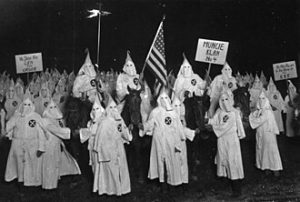
An Indiana Klan gathering in Muncie, Indiana in 1922
Grandpa grew up in Muncie, Indiana! And in 1922 he would have been old enough to join.
Is he in this photo?!?!
Surely not, I thought, but I needed to know more.
The First and Second Klans
I didn’t even know there was a First and a Second Klan. I knew about post-emancipation white robes, Grand Dragons, cross burnings, and lynchings, of course. And about modern-day white supremacy groups. And, by now, I know the difference — that the First Klan (mid-1800s) operated as a clandestine paramilitary group that utilized night riding, beatings, and murders, whereas the Second Klan (early 1920s) operated openly, held public parades, functioned as a “fraternal lodge,” and aimed to dominate local and state politics.
This song — Your Friendly Liberal Neighborhood KKK — was written by June Reizner (aka Bernie Cross) and recorded in 1965 by The Mitchell Trio, featuring the familiar face and voice of John Denver, who replaced Chad Mitchell. It is categorized as political satire and it captures my understanding of the Second Klan perfectly. The Klan’s goals were whitewashed (so to speak) to the point of being socially acceptable to even otherwise-nice folks. The Klan promoted itself as a “100% American” organization, targeting immigrants, Catholics, Jews, and Black Americans. (Um, sound familiar?)
It was pure serendipity that Julie Bestry sent me the song without knowing what I was writing about at that very moment!
The Second Klan was not exclusively located in Indiana, of course, but Muncie — where my grandpa grew up! — was the epicenter of the Klan’s resurgence in the 1920s — when my grandpa was a young man!
Some facts of the case:
- The book club selection in question was A Fever in the Heartland: The Ku Klux Klan’s Plot to Take Over America, and the Woman Who Stopped Them by Timothy Egan. I hadn’t yet read it when my aunt and I were talking about Grandpa, and I didn’t yet know that much of the action takes place in Muncie, Indiana.
- The period of time when “everyone” was joining the Second Klan in Indiana was 1922-1925. According to the book, The Klan had control of everything — local businesses, law enforcement, government. Joining the Klan seemed to many to simply be the patriotic thing to do.
- Although the Second Klan did keep membership records, most of the Indiana records were destroyed after the trial of Grand Dragon (and convicted rapist and murderer) D. C. Stephenson in 1925. Many Klan members didn’t actually quit, but simply fell away after that.
- My aunt is an unreliable witness. Meaning, she wasn’t there at the time, and wouldn’t swear in court to any particular memories of her own. She was born in 1938 and the family left Indiana for New Mexico in 1945 when she was 7. (I got the impression the dress making happened in Indiana.) She said it was something she had been told, presumably by one or both of her parents. The fact that she doesn’t trust her own memory is what makes her “unreliable”. But it also speaks to a possible kernel of truth in the story.
- I asked a genealogy cousin (a distant cousin I had not grown up knowing who still lives in Muncie) and she had not heard of any stories like this in her branch of the family. But then, neither had I.
Deciding factors?
George Dewey Hankins (1898-1974) was an interesting fellow. Grandpa would have been 24-27 years old in 1922-1925. He left high school early, returning to a regular classroom as an adult — a very unusual thing to do at the time — to graduate at age 28 in 1927. He didn’t marry until age 32.
I’ve already written a couple of posts about him, including this one:
And there are several more posts about him that I could — and may yet — write.
At first I thought maybe he did join when everyone else did, like my aunt said, without knowing, really, what the Klan was all about. But the more I learned, the more I realized he would have had to pay money and take an oath to join, neither of which sounded like what I knew of him. In 1925 it cost $10 to join, and $6.50 for the white robe, for a total of $16.50, which is the equivalent of around $311 today. That’s a lot for someone who spent most of his adulthood wearing a ponytail because he didn’t want to pay for haircuts!
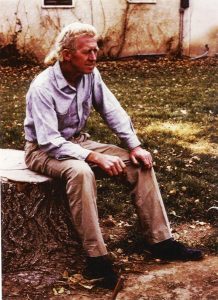
Another thing about Grandpa is that he kept records. He wrote a diary and tracked his expenses. My brother has all of that documentation, and we found nothing at all about the KKK. He has written about other strong opinions, and it seems to us that he would have written about the Klan if he had felt strongly about joining, or about not joining, or about joining and then quitting, for that matter. Although it’s possible he did not record his Klan thoughts or expenses, or got rid of the evidence later, I think it’s more likely that it never happened.
What we did find, meanwhile, are records indicating that Grandpa was homesteading in Colorado during that time. People in Colorado joined the Klan, too, but there is no evidence that he was among them.
I do think it’s possible that many of the adult white men in his life were members, though, even if only briefly. There seems to have been a good deal of peer pressure involved.
Finally, although I haven’t found photographic evidence yet (I’ll be keeping an eye out when I get back to working on photos), I would not at all put it past him to have obtained Klan robes for cheap or free for Grandma to make dresses out of for their three little girls. Times were hard, and they did, after all, buy a gangster’s hideout to live in, because it was cheap and no one else wanted it!
The verdict
I’ve ruled that George D. Hankins is not guilty of joining the Klan due to insufficient evidence that he did.
If he did join, and if he did quit after realizing what they really stood for, the only way I can understand it is to think of today’s Republicans who are decidedly not MAGA. They may have voted for Trump the first time, but then realized, “Nope. This is not what I signed up for.”
Case closed?
So, although the case has been closed, much like the crime cases on TV, and as with all genealogy research, it is subject to being re-opened if future new compelling evidence comes to light. If it does, I will update this blog post.
Have you ever had a family story that you weren’t sure was true?
Did you investigate and were you able to prove or disprove it?
Please share with us in the comments below!
- Hazel Thornton is an author, genealogist, and retired home and office organizer.
- Book: Hung Jury: The Diary of a Menendez Juror
- Book: What’s a Photo Without the Story? How to Create Your Family Legacy
- Book: Go With the Flow! The Clutter Flow Chart Workbook
- Feel free to link directly to this post! Click here to ask about other uses.
- Copyright 2026 by Hazel Thornton, Organized for Life and Beyond
__________________________________________________________________________________________
Share this:





I love this story. Our remembrances of what we were told can be so wrong.
I have been working on gathering pictures and other memorabilia for our family reunion. I was talking with one of my sisters about our father’s father and how he died. We had completely different stories on that except that both of us remembered it had to do with drinking too much. I had him dying in a railroad accident while working in the yards. My sister had something entirely else. While talking with my other sister, she confirmed my first sister’s story and told me that the story I was remembering did happen but on the other side of the family tree entirely.
My son, Ben, has said that he has some questions about our history. I told him that he needed to bring them up at the reunion, where he might get several answers.
Tell Ben it’s fun to research family stories and determine the likelihood of them!
Wow, that is so interesting, Hazel. Thanks for sharing your search results.
I wish I could get more information on my grandparents in Italy. It’s hard to find information about my ancestors there. I was told that one of my grandparents was a fascist and they were forced to change the spelling of their last name when a political person who had the same last name wanted to run for mayor. Weird, right?
Peace to you.
Or….maybe they changed the spelling themselves, because they didn’t want to be associated with the politician?
Well, I wish I had a fun story to share, but I don’t.
It’s fun to see how you went about researching this. I didn’t know there was a First Klan and a Second Klan either. I never heard about it (being from Philadelphia area). If it was active there, I had no idea.
Also, I like your conclusion that there is insufficient evidence, and furthermore your acknowledgement that people can visit a meeting or join a group without full knowledge. Stepping back after seeing the full picture is actually a good story to tell, perhaps contributing more to character than anything. Many books read differently than they look on the cover.
The Klan was definitely active in Philadelphia in the ’20s, and there are definitely still records that could be perused! Just google Philadelphia KKK records.
Hi Hazel!
What a wonderful story! I didn’t know much about the Klan so it was a learning experience as well! Without a time machine, you’ll probably never know the whole story!
Franklin Wilberforce Thornton was my grandfather. He married my grandmother in 1893 when she was 21 and he was 37, a widower with two children. I think about how young she was and wonder whatever happened to his two older children. He went to prison when my father was about 4, so my grandmother was left with a husband in prison and at least 3 small children to care for. She divorced him while he was in prison, I think, and remarried.
My mother told me that because my father’s stepfather let him cut his hair (long curls weren’t what boys were supposed to wear at the time), my father took his stepfather’s last name. Your book, What’s a Photo Without a Story?, helped fill in some gaps in FW’s history for me and explained why my father didn’t talk about him and the more likely reason he changed his last name.
Hi Robyn how nice to hear from you again! I thought of you when I wrote about FWT.
Thanks! since we’re somewhat related, I love reading about your family!
Hazel, your story is so interesting that it makes me wonder what stories my family might have. It also makes me wonder if we all have stories that are so interwoven into the history of the time that somebody somewhere might be interested in those stories in 100 years even if we don’t think anything of those stories when they happen to us (Pandemic times, for instance).
Thanks for sharing and inspiring. I admire your research skills and your love of geneology.
Jill, I definitely think people 100 years from now will be interested in our Pandemic stories! It’s hard to imagine it, though, when we’re living it. Thank you for your comments!
Your stories are always so interesting!
I was surprised to find a document in my grandfather’s scrapbook representing a time he was charged with trespassing when he was 19. You’d wonder why he’d keep it and consider it scrapbook-worthy, but obviously it was to him.
His address is listed on the document as a local college, and the same scrapbook page includes a photograph of the institution as well as the college crest. It’s highly unlikely he was a student and I’m guessing he may have worked there.
He passed away before I was born, so I never got to know him.
Well, those are certainly curious clues to getting to know him better! I’m glad you liked my story, Janet!
I’ve uncovered numerous true family events that were hidden or covered up. Mostly due to intuitive or psychic gifts that were verified later. Here are 3 examples:
1. My Mom was not my birth mother. My “aunt” gave birth to me. It was a big cover up. Discovered in mid life vision. Verified by my mom and aunt’s best friend who was a nurse attending at my birth which happened in her home and not the hospital as I was told.
2. My paternal grandmother’s mother was Native American. Her Native mother died when Granny was 4. She was raised “white” by her adopted parents. She just had light “tan” skin so got away with it. The story was revealed when I was 12 and again I had a vision. She shockingly started crying when I told her the vision of a Native American woman singing to her. She was always laughing and joyful. Granny then related the story about the few memories she had as a young child. She hadn’t spoken of it in 50 years as her white parents told her to never speak of it.
3. Still trying to verify if this is true or not. I was told my family that we had ancestors on my father’s side who was a minister in England and that I took after my great, great?? aunt Annie who was “weird” (meaning she had weird visions also). Also, that there was a Moberly family English coat of arms. As an adult I came across a large book I believe was called the Encyclopedia of Divination or something to that effect. In the book was a story about one of the daughters of George Moberly, who was the Bishop of Salisbury England Church. Elizabeth Anne Moberly was the first principal of Hughes College for Women which was affiliated with Oxford University. She and her friend went on a trip to Versailles France and had a “time travel” or mystical experience back to a vision of Queen Marie Antoinette at an outdoor party. As intellectuals they thought they had just encountered a costume party, but then discovered that there was none and the garden view that they saw had been walled off a long time ago. After 10 years of trying to investigate and make sense of what happened, they eventually wrote a book called the Ghosts of Versailles under pseudonyms to protect their reputations and prevent ridicule.
Well, that was an interesting rabbit hole you sent me down with your item #3! You probably know all about the “Moberly-Jourdain incident” Wikipedia page, and the 1981 TV Movie “Miss Morrison’s Ghosts”, based on the incident. (Also the opera called “The Ghosts of Versailles” which is apparently unrelated.) There’s no way to fully explain what they saw, or said they saw, but you can certainly determine your relationship with Elizabeth Anne Moberly!
Actually I didn’t know about the movie. I’ll attempt to see if I can find it to view. Thanks for the info. I certainly have similar experiences with Annie, but have not yet proven through records research that she was a direct ancestor.
Well, chances are she’s not a direct ancestor. But I’d bet she’s a distant cousin, at least. And it’s still a good story, especially given your psychic affinity for her!
Thanks. We did find the movie on You tube. plan to watch it. From the review It appears to have been inspired by the Annie event . but changed to sisters about a relative. Movie decisions are always “interesting ” as to why they change a true story into a fictional.. probably has to do with copyright laws. It appears that another Moberly ancestors that I don’t know took the original book after copyright expiration and reprinted the book.
Looking back on my generation, my grandnieces would conclude that every woman burned her bra and was a feminist. Of course, not so. My Mom told me that “everybody’ was patriotic in 1940’s. Not so either. But culture has a loud voice so be sure to check your facts.
On another note, family lore had my paternal grandfather “bumped off” by the Italian Mafia. Actually, the story is even more interesting. Grandpa Harry was himself a gangster, a Jewish gangster, murdered by a fellow gang member.
Ha ha — I’ve heard you tell stories about your gangster grandpa! You make whatever you’re talking about super entertaining. Thanks for chiming in, Judith!
Great story Hazel!!
Thanks, Kathy!
I love the serendipity of me sending you the video as you were working on this post; I also realized that I somehow (when I had a million open tabs) wrote and entire post and then when I had to restart the computer, lost the content in this tab for these past five weeks. Nonetheless, thank you for writing this fascinating blog post! I always find your stories compelling.