
Rete Ovarii — Good news for women? And/or medical sexism?
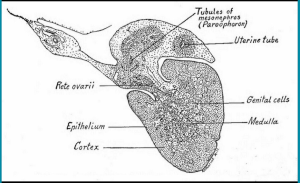
Rete ovarii pronunciation: REE-tee oh-VAIR-ee-eye. Google tells me this diagram of the ovary is from a 1915 laboratory manual and textbook of embryology.
It is well known and well documented that women’s health issues have been under-studied as compared to men’s health issues. If you weren’t aware, or if you doubt it, just Google “male bias in medical research”.
And this one I’m taking personally.
Why? Because a part of the female anatomy has been “found” that might have played a role in my own quality of life had it not been “lost” to begin with. So, this post is about me. But, if you are a woman, it might just be about you, too.
NOTE: I really wanted to call it “medical misogyny” because I was mad and the alliteration had a ring to it. But I don’t think it is hatred that causes women’s issues to be neglected; rather, historically, a patriarchal sense that men’s issues are more important to male researchers than women’s issues are.
Why am I writing about this, and why now?
This blog post was triggered by two recent events: 1) a video I found in my social media news feed, and 2) an article sent to me by multiple friends. I believe these newsworthy health topics are related, and sometimes when I get asked a lot of questions about something it’s just easier for me to write about it.
The video:
Comedian Michelle Wolf — who often talks in a funny way about serious topics — posted a video about how they’ve REDISCOVERED an ENTIRE ORGAN in the female body called rete ovarii. It was first discovered in 1870 and then IGNORED for 150 years to the point where it was REMOVED from medical textbooks and diagrams because they didn’t think it was important. So, nobody learned about it. Meanwhile there’s a male counterpart — rete testis — that has, yes of course, been extensively researched.
SERIOUSLY, WTF???
How many women have suffered ovarian symptoms that may have been affected (harmed or helped) by the rete ovarii? And WHY do we have to learn about this from a COMEDIAN in 2026?! (Thank you, Michelle!)
Watch it, it’s good:
The article:
Meanwhile, friends who know I have lipedema sent me the new Women’s Health article: “This Condition Is Often Mistaken for Obesity. But Diet, Exercise, and Medication Won’t Fix It” by Amy Wilkinson. The article was picked up by Apple News, but both outlets are behind a paywall, so I haven’t read it. What I have read, though, is this one which has no paywall:
What the Women’s Health Lipedema Article Got Right — And What Comes Next
by Catherine Seo
Freak of nature – early menopause
So, I entered perimenopause 50 years ago.
No, not when I was 50 years old — 50 years AGO. When I was 19.
Yes, I am a freak of nature. Every bell curve has its outliers!
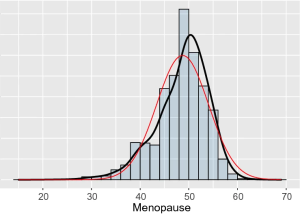
Source: https://www.nature.com/articles/s41598-022-25475-w/figures/1
When I first realized my period was late, I logically thought I might be pregnant (despite having used contraceptives). Not the best situation for an unmarried preacher’s daughter to find herself in! (My parents never knew, and they’re both gone now.) Abortion was illegal in Idaho at the time — which it is again now, 50 years later, grrr — and I had already scoped out the cost of a bus ticket to Seattle, where it was legal then and still is.
Fortunately, it was a false alarm. I went to Planned Parenthood, where they determined I wasn’t pregnant after all. Whew! Over the next year, though, I developed all the symptoms of perimenopause — mainly irregular periods, hot flashes, and mood swings. Something was clearly wrong, but who thinks of menopause for a 19-20 year old? (A nurse friend of mine, that’s who.)
At one point I remember sitting in a doctor’s office across the desk from a male OB-GYN who was perusing a medical manual while contemplating his next move. He had given me a hormone injection, the result of which was either that it stimulated a period, or it didn’t, when it was expect to, or not expected to. I don’t remember which. He said, “If you wanted to get pregnant, I would know what to do.” (Being Mormon, he was well-versed in the baby-making business.) “But since you don’t, I have no idea. It might be a brain tumor. It’s a good thing you are moving to California. They might be able to figure it out there.”
After worrying that it might be a brain tumor for several more months, they did, in fact, figure it out in California. At the time it was called Premature Ovarian Failure (POF). Nowadays it’s called Premature Ovarian Insufficiency (POI).
The solution, for me, was decades of hormone replacement therapy (HRT). It came in various forms over the years including birth control pills and estrogen patches. Some treatments produced regular periods, and some didn’t. Good thing I didn’t want children, because having my own wasn’t in the cards. At least not in those days. I never did end up wanting them, either, so no one needs to feel sorry for me on that account.
Fast forward 30 years — enter lipedema
After a couple of false attempts at weaning myself off the hormones (ugh, hot flashes again!) I eventually stopped taking them. No periods. No symptoms. Menopause. Done. Yay!
Then, but oh-so-gradually — and related to menopause only in retrospect — I started developing symptoms in my legs that took years to diagnose. I have not written about my personal symptoms, my difficulty in getting diagnosed, or about what my treatment involves. So, you haven’t missed it, in case you wondered.
I first mentioned lipedema in a blog post about invisible illnesses. Lipedema is a connective tissue disease which, if not managed well enough, can constrict the lymphatic system and lead to lymphedema swelling and complications. It involves a type of fat which does not respond to weight loss efforts. Think scar tissue. I am also obese, which involves a completely different type of fat, and which makes it easy for doctors to overlook other symptoms and insist that I should just lose weight.
BLOG POST: Not all disabilities are visible

NOTE: Look for the two sections in the blog post that address lipedema and include some resources: “When invisible isn’t exactly invisible,” and “Lipedema affects mostly women.”
I’m still learning about lipedema. And educating my doctors about it as I go. I’m not bragging, or exaggerating. I’m just saying that most of them didn’t already know about it. And my experience is not unique. Just the other day I was seen by a med student who pressed her finger to my calf to see if the indentation stayed or disappeared quickly.
Me: You’re checking for lymphedema, aren’t you?
Med student: Yes.
Me: Have you heard of lipedema?
Med student: No.
Me: Would you like to know about lipedema?
Med student: Yes.
So, I told her the basics and she seemed appreciative. (I was also seen by my regular doctor in the same visit.)
Lipedema is one of the many under-studied conditions that affects women almost exclusively. I first attempted to get help for my symptoms in 2019, and was not diagnosed until 2024. If I had known the word “lipedema” I could have Googled it and asked my doctors about it by name. And if they had ever heard of “lipedema” they could have stopped poking my legs and deciding nope, she doesn’t have lymphedema. Even so, it is coded in the United State, for insurance purposes, as lymphedema. Because some, but not all, lipedema patients do also develop lymphedema. It was only this year, in 2026, that a dedicated ICD-10 diagnosis code was proposed for lipedema, which is great but it won’t become effective until October 2027.
NOTE: Other countries use ICD-11 and have codes for lipedema already. Don’t get me started.
What’s the connection?
So, what does lipedema have to do with early menopause? (Or regular on-time menopause, for that matter.)
Hormones.
Although much about lipedema remains a mystery, one thing that seems well agreed upon is that symptoms are triggered by hormonal events such as menarche, pregnancy, and menopause. Every woman is different, though, which probably throws researchers for a loop.
While lipedema is widely misunderstood and underdiagnosed, it is not rare. Lots of women have it and don’t even know it. They have asked their doctors about individual symptoms and simply been told to lose weight, as if that were a cure-all. Not all lipedema patients are obese, either. It comes in various types and stages.
NOTE: If I could find an illustration I like I would include it here. But I get a headache every time I try to choose amongst the many that are floating around in cyberspace. Some are better and more helpful than others in illustrating the types, stages, and symptoms, but most of them are inconsistent in some way with reality, and with each other, and I fear it would just generate more questions than I have answers for.
But once you know the word lipedema it’s much easier to learn about it! I’ve had doctors take what I have to say about it to heart, learn more, and add it to their notes on my charts. And there have been others who looked at me like they were thinking, “You are mispronouncing lymphedema, aren’t you? OK, silly woman. Whatever.”
What’s next?
Will the rediscovery of the rete ovarii make a difference in my life going forward?
I don’t know. Probably not. There are so many articles popping up about this that I haven’t had a chance to read them all.
Would knowledge of it have changed anything in my past?
Who knows? Maybe.
Will it make a difference in the lives of other women especially young ones just starting out?
I hope so! Only time will tell. It certainly will help that people are becoming more aware of lipedema and asking their doctors about it.
Am I hopeful about the re-discovery of the rete ovarii? Or infuriated?
It depends. I’m cycling back and forth between the two. And wondering what else has been ignored/missed/hidden that could make a difference.
What are your thoughts?
Please share (if you feel so inclined) in the comments below!
- Hazel Thornton is an author, genealogist, and retired home and office organizer.
- Book: Hung Jury: The Diary of a Menendez Juror
- Book: What’s a Photo Without the Story? How to Create Your Family Legacy
- Book: Go With the Flow! The Clutter Flow Chart Workbook
- Feel free to link directly to this post! (Click here to ask about other uses.)
- Copyright 2013-2017-2026 by Hazel Thornton, Organized for Life and Beyond
__________________________________________________________________________________________
Share this:







My thoughts are that women have been woefully overlooked by the medical community. Understudied, not taken seriously, talked down to, etc.
I am aware of lipedema (which interestingly I’m being told by ‘spellcheck’ is a misspelled world…) and have been following some people on facebook who talk about it. I’m thankful for communities of people who can share with a small, widely spread group of people with similar conditions. IMHO, this has been one of the major benefits of the internet. We don’t need to rely on one or two doctors who may–or may not–have experience with a condition.
I’m much more likely to seek answers this way that I would have originally thought. Turns out doctors don’t know a lot. Also, people with conditions know a lot, and have a lot of great information to share.
I’d never heard of the rete ovarii. Now that I have, I won’t forget it!
AND, sorry that you are having to live with lipedema.
I agree that the internet, including virtual communities, can be a wealth of information! Just like in real life, one has to consider the source(s) when weighing advice. And everyone’s different. For example, many with lipedema feel better on a very high protein diet. But I have kidney disease and can’t eat the amount of protein they are talking about. And it just figures that Spellcheck doesn’t know the word lipedema, right? (My WordPress has underlined it with a squiggly red line. There, I just added it to the dictionary.) Thanks for chiming in, Seana!
Intriguing. Women have definitely been medically ignored. “Ignored” is not a strong enough word. I have always forged my own path: Lamaze childbirth, breastfeeding (slightly before it was popular), treating symptoms (self diagnosed) with Homeopathic remedies, treating symptoms with essential oils. All those things have worked for me. My blood pressure is normal to on the lower side. My cholesterol is perfect. To my knowledge, I don’t have any health conditions. However, I recently experienced about a month’s worth of very strange symptoms. Some severe brain fog really scared me and prompted an appointment with my medical practitioner. So far the medical tests ordered have revealed nothing. I’m still waiting on a few more results.
When I started realizing the multiple weird symptoms, I put them all together in a search bar and it came up with Sjögren’s Disease. I freaked out a little because it can lead to other issues, like lymphoma and heart & lung issues. Currently, I am feeling more like myself. So, what was it? And will the medical professionals take it seriously. I can’t stress enough that I’m not a complainer, not a hypochondriac.
There’s so much more we could talk about regarding hormones, though! Maybe another time.
The flip side of the internet being so helpful is that it can also lead us down the wrong path, since so many symptoms are common to so many conditions. So try not to freak yourself out! Sounds like you’ve been doing a good job. And yes, it’s a big topic! Thanks for your comments, Janice.
Hazel, Some of what you wrote in this blog I never knew about you. But considering that I as your aunt, went through similar hormone problems in my early life, some of what you experienced could be hereditary. Afterall, I too experienced menopause at a very early age and was even told by an OB-GYN that I would never have children….although I never wanted to anyway.