
What’s in a name? (family naming patterns)

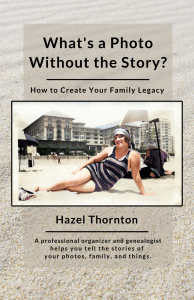
Who (or what) were you named after? I was named for my paternal grandmother, Hazel Islery Clay Thornton, the “bathing beauty” on the cover of my book What’s a Photo Without the Story? How to Create Your Family Legacy. My mom was named for her maternal grandmother, and my dad was a Junior.
Why are family naming patterns important?
I love family naming patterns as much as I love family resemblances. They can be entertaining, helpful, touching, and mystifying. They can also help you find more ancestors and confirm your findings. How?
- Entertaining: I find most of the naming patterns discussed in this blog post to be entertaining! My own mom named her children with rhyming first and middle names that are fun to say. I can’t list them all due to privacy considerations, but I can tell you the first two: Hazel Kay and Michael Ray.
- Helpful: Keep an eye out — one way you might get lucky is that the first or middle name of a child might be the elusive maiden name of the mother. (More on that later.)
- Touching: I recently realized that my 2nd great-grandmother Emma Cook Lawrence named her son (my great-grandfather) Horace Warren Lawrence in honor of her presumably-dear, closest-in-age brother, Harrison W. Cook. I knew about Harrison W., but not that he went by the nickname Horace and that W. stood for Warren. And not that he died in the Civil War when he was 20 and she was just 15. I found this to be not only touching, but also a helpful indication that I had identified the right wife for James Henry Lawrence.
- Mystifying: My maternal grandmother’s first name is Villa. Where the heck did that come from? And Norfulet Byrd. Is Norfulet a typo? A surname? And why did my mom say, before she died: “Oh, by the way, Emma Lawrence’s real name was Minerva Jane Kibby.” What?!?! I guess those are the opposite of patterns, but perhaps one day a pattern will reveal itself and help solve one of the mysteries.
Not all families have strong naming patterns, but many do! It’s not something you can count on — I think it’s equally as interesting to note when a family did not follow a pattern, as when it did — but noticing them, and learning which common patterns might apply to your situation, can help you piece your ancestors’ families together and learn more about them.
Here are a few I’ve noticed:
English/Irish/Scottish Tradition
Here’s the traditional naming pattern:
1st son named after paternal grandfather
2nd son named after maternal grandfather
3rd son named after father
4th son named after father’s eldest brother
5th son named after mother’s eldest brother
1st daughter named after maternal grandmother
2nd daughter named after paternal grandmother
3rd daughter named after mother
4th daughter named after mother’s eldest sister
5th daughter named after father’s eldest sister
In my family tree there are eight Thomas Thorntons. There are also nine James Reeds and six John Clays. My namesakes are, for the most part, spaced out enough in time that I am not confused. But you can end up with a real puzzle if all the sons in a large family stick together in one geographical location and they all name their sons in the same traditional manner. (Does this record pertain to the father, or to his son? Or maybe his nephew?)
The Biblical Robbinses
I have never found any direct evidence that the father of my 4th great grandfather, Noah Robbins, Is Daniel Robbins. Why, then, have I included Daniel, and Daniel’s father Isaac, on my pedigree chart? It’s because in genealogy we also consider indirect evidence. I know that Noah Robbins migrated from North Carolina to Indiana. And I know that a bunch of other Robbinses also migrated from North Carolina to Indiana in the same time frame.
From what I know of the individual families, from other records, the one that comes the closest to being in the right location at the right time, with other children around Noah’s age, is Daniel’s. The years when Noah might have been listed by name on a census with Daniel were pre-1850, the first year all household member names were listed with the head of household. Another clue is that all these related Robbins families had a tradition of giving their sons biblical names. This family is not unique in using biblical names, but I haven’t seen one that uses them as extensively as this one did.
Andrew, Daniel, Eli, Elisha, Elzey, Ezekiel, Hiram, Isaac
James, Jacob, John, Jonas, Jonathan, Joseph, Joshua, Josiah
Mathias, Michael, Moses, Noah, Solomon
I have seen only one use each of these biblical names in the applicable timeframes and locations. If there were another Noah in the same time and place, that would open it up for “my” Noah to belong to another family. But there isn’t another candidate family thus far.
What are the chances that Noah is not a member of this extended family?
I wasn’t even planning to mention the female names, assuming them to be a mixture of biblical and non-biblical. But I started looking them up and found out that more of them were biblical that I thought! A few examples:
Sarah – yes, of course. But also: Tabitha, Priscilla, Rhoda, Anna, Elizabeth, Keziah and Jessie.
The Virtuous Quakers
My Quaker ancestors go back as far as Quakerism itself, which was founded in mid-17th-century England by George Fox. That is, until they started marrying non-Quakers and committing other such infractions. (See Thornton Family History Lost and Found.)
Quakers (and Puritains) often gave their children names that reflected the virtues they wished them to be associated with. These are known as virtue names or grace names. Here are some examples from my family tree. They are all female names unless designated (m).
Charity, Reason (m), Patience, Grace, Thankful, Pleasant (m)
Unity, Temperance, Mourning (I don’t get this one either)
The Patriotic Hendersons
Although the Hendersons in my family were Quakers, they were apparently also very patriotic, as shown by the names of this father and his sons:
Thomas Jefferson Henderson b. 1809 (Thomas Jefferson, 3rd U.S. President, 1801-1809)
Shadrack Jackson Van Buren Henderson b. 1839 (Andrew Jackson and Martin Van Buren, 7th and 8th U.S. Presidents, 1829-1841)
James Madison Henderson b. 1848 (James Madison, 4th U.S. President 1809-1817)
And, by searching my Ancestry database I found a number of instances, in completely different branches of my tree, of honor being paid to the Father of Our Country:
George Washington Cook
George Washington Keesling Sr.
George Washington Keesling Jr.
George Washington Lear
George Washington Boykin
George Washington Smith
George Washington Reed
Here are a few more patriotic examples:
Robert E. Lee Lawrence b. 1875 (Confederate General Robert E. Lee lived 1807-1870)
James Monroe Speed b. 1818 (James Monroe, 5th U.S.President, 1817 – 1825)
James Monroe Taylor b. 1866 (James Monroe, 5th U.S. President, 1817 – 1825)
Thomas Jefferson Thornton b. 1845 (Thomas Jefferson, 3rd U.S. President, 1801-1809)
Unusual first and middle names can be the best clues!
Let’s look at Abraham Garr Henderson. His middle name — Garr — is his mother Eliza’s maiden name. If I hadn’t already known her maiden name it would have been worth a search to see if it might be Garr. Abraham is not even my direct ancestor. He’s my 2nd great-granduncle.
Although I’ve only included this one example, and you can’t count on it, it happens often enough to be worth keeping in mind. And that’s why you need to research the children and siblings of your direct ancestors as well as the direct ancestors themselves!
Reusing the names of your own deceased children
This might seem kind of morbid, unless you lived in a time and place where it was common. If it looks like you have duplicates in your tree, it might be that one child died and a subsequent child was bestowed with the same name. I don’t have any handy examples, but I’ve seen it in a few of my branches, and those of genealogy clients (before I retired).
AI Overview
It was popular in early American, European, and other cultures, particularly between the 16th and 19th centuries, to reuse a dead child’s name, especially when infant mortality was high. This practice was a way to cope with grief and preserve the family name and continuity. The tradition was so common that parents would give the same name to a new baby and would continue doing so until a child with that name survived to adulthood.
Catholics
While researching for one of my genealogy clients (before I retired), I encountered a family on the census with a large number of children. Although Catholics are known for having large families, or at least they were several decades ago, I didn’t know the family was Catholic. All I knew is that all of the boys on the census record were named Joseph and all of the girls were named Mary. What?!?!? As I was trying to figure out why, I noticed that all of their neighbors also had multiple children named Joseph and Mary! I’ve heard of drunk census takers, and those with sloppy handwriting, writing things down however they heard them, and relying on whoever answered the door to provide the information, but what was going on here? After a little Googling, I confirmed that some Catholics in some areas really did name all their kids Joseph and Mary. And all those kids in their daily lives go by their middle names: John, Thomas, Margaret, Elizabeth, etc.
African-Americans
OK, so this one’s not as entertaining as the others.
When tracing African-American ancestry, the process is the same as usual working my way back in time to 1870, the first census after the Emancipation Proclamation in 1863, and the first time former slaves were listed by name with their own families. Prior to that they were enumerated as property and, most often, not even recorded by their names but by their gender and age.
Some slaves, after emancipation, adopted the surnames of their former owners. But others chose new surnames for themselves, or adopted African naming patterns, to create a new sense of identity. So, while it is always worth looking in the area for a slaveholder with the same surname, it is not proof one way or another without additional evidence. What sort of evidence? Such as living right next door to the former slaveholder in question. Or being listed by name in their will. (See also Black Lives Matter in Genealogy Too)
Genealogy is a Matching Game
Remember the children’s game called Concentration, or Memory, in which you turn over cards and try to remember where else you saw that same card? (There are many versions of this game, with many names.) During the writing of this blog post, but entirely unrelated to it, I was looking at the 18th century Byrds for a not-so-fun reason — to see if their wills listed their slaves by name, so I can add them to the 10 Million Names Project. I found a brief court note that mentioned Enos Byrd’s probate administrator, Keziah. As soon as I populated her first name into Ancestry as probably being his wife, several hints popped up indicating that her father’s surname was Denby and her mother’s was — well, how ’bout that? — Norfleet. Ding, ding, ding! Remember Norfulet Byrd from earlier in this post? (I have also seen it as Enorfleet, Noflete, and Noffleet.) This is a strong indication that not only was Norfleet’s name commonly misspelled, but that I guessed right about Keziah being Enos Byrd’s wife.
Do you know where your name came from?
Does your family use one of these naming patterns, or a completely different one?
Please share with us in the comments below!
______________________________________________________
- Hazel Thornton is an author, genealogist, and retired home and office organizer.
- Book: Hung Jury: The Diary of a Menendez Juror
- Book: What’s a Photo Without the Story? How to Create Your Family Legacy
- Book: Go With the Flow! The Clutter Flow Chart Workbook
- Feel free to link directly to this post! Click here to ask about other uses.
- Copyright 2025 by Hazel Thornton, Organized for Life and Beyond
_____________________________________________________________________________
Share this:




how amazing that we both felt like sharing something about naming at a similar time.
yours is a robust and interesting post and mine just a short description i’ll copy here:
what’s in a name?
one of my grandfathers was born in 1903, a mixed-race man to a Welsh mother and silk merchant from Lahore
if i thought it was challenging in the 70s and 80s, i can only imagine his discomfort.
he changed his name from You’ssuf Ramatullah to Hugh Randall.
my father dropped Rastogi from his name to live as Ved Kumar with no trace of caste.
my middle sister prefers her middle name Nisha to Helen, and now goes by Anisha.
my middle name is Shanta. it means peace.
i wonder how would my life be different if i’d worn this name.
i normally provide my name as Clare Kumar but i always sign with my middle initial noted.
here, i’ve noted my full name with a new sense of pride. i’ve mostly reserved the use of Shanta to connect with other Indian people.
thanks for the post!!
Shanta, how pretty! And so many different reasons to change one’s name. In my post I mentioned my name rhymes with my brothers’ names. (Hazel Kay, Michael Ray, etc.) My mom always had a name in mind in case she had another girl — Janelle Gay — and, in mid life (when it was clear there would be no other girls) she changed her own name from Ethel to Janelle. Ethel rhymes better than Janelle (her given middle name was Ruth), but that wasn’t the point. By then she had divorced my dad and was looking for a fresh start. Oddly, she kept Thornton as her surname, saying she’d had it longer by then than she’d had her maiden name and was used to it. LOL. Thanks for chiming in!
When, as a young child, I complained that my older siblings got my parents’ first names as middle names, so they had to name me after the queen. My mother explained that my middle name, Elizabeth, came from her best friend. Since I didn’t know any friend of hers named Elizabeth, I thought no more about it until her memorial service. Her cousin Betty (who wasn’t a total stranger to me) said that she and my mother were best friends as kids and that’s when I pieced it together.
I’ll bet that put both your mom and her cousin into a new light in your mind. (There’s probably a better way to say it. Some combo of shedding new light on, and putting into perspective.) It’s amazing how many times family information is misheard, or misunderstood, or not shared, or not shared adequately! And nicknames — how is it that Polly is a nickname for Mary? And why Jack for John? (Both same number of syllables. Why?) Thanks for sharing your story, Janet!
My name came from a little girl my parents lived near when my mother was pregnant. She just liked the name. Little did she know that it would lead to her daughter spending her life either spelling or saying her name, that very few people get right LOL!
It’s okay, though. I’m used to it. My family just didn’t pass down names. Not our tradition. Although my Dad had the same name as his father, that’s about as close as we get.
Very interesting to see all these options, though. Great research on your part!
Hi Seana! I can see how your name could be problematic for people who have truly never seen or heard it (or Sean) before. I guess there’s a first time for everyone. English-speaking folks don’t really have a problem with Hazel, but I ha-a-ate having to spell my name on the phone, and I always do, because they never hear it right. No, it’s a T, not a P. THorNton, like a ton of thorns. Thor-N-ton. Usually I don’t care unless they are having trouble finding me in a database.
What a fascinating description of naming conventions and also how they played out in your family!
In the Jewish tradition, it’s common to name someone after a deceased relative. But naming after a living relative is rarely done. My father, sister and brother don’t have middle names. My brother, Tod, was named after Mary Todd Lincoln. My sister and I don’t know who we were named after or why my parents chose those names (Julie and Linda). My middle name is Nan, and I was named after my maternal great-grandfather, Nathan.
They other Jewish naming tradition is you can name someone after a deceased relative. It doesn’t have to be the exact name, but the first letter of the name can be used to honor the memory of that person. So for example, the “N” in Nan, my middle name coordinates with the “N” in Nathan, my great grandfather.
Hi Linda, thanks for adding the Jewish perspective! I like how Nan also coordinates with the “an” in Nathan.
Loved all of this great information on names and the chance to reminisce about some of our family names. I was always told that I was supposed to be a boy and was to be named after my father, John. I also heard that my mother had in mind Jonda if I was a girl because she had seen that name listed as a support actress in a movie. No idea at all where my middle name Sue came from. I don’t see it anywhere in my family tree.
For my sons I gave each of them a middle name from a grandfather plus a first name that was not already in the family. My first son was Darin John – John being my father and my mother’s father My second son was to be named Benjamin Ashlie – the Ashile being my husband’s father’s name. But my husband insisted that I change it around to Ashlie Benjamin because our last name was Hocking and he didn’t want his initials to be BAH. So, Ashlie Benjamin it was but we called him Ben.
Ashlie being a southern male name was also a female name. When Ben applied to Georgia Tech they first assigned him to a female dorm. Ben was all for letting that pass and see if they would notice but I make him change it.
Interesting info!
Thanks for reading my post, Kimberly!
I never knew there was so much history and meaning behind naming patterns! This made me think about how my own family chose names and what traditions we might be carrying on.
And this is only the tip of the naming iceberg when you consider all the ethnicities and religions I haven’t personally researched! Thanks for your comment, Olivia.