
When Genealogy and Historical Fiction Collide
NOTE: Don’t worry, this post doesn’t contain spoilers!
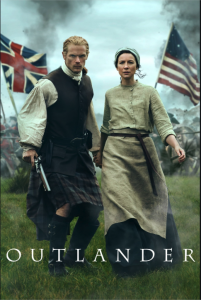
I have long been a fan of the Outlander series of books by Diana Gabaldon. History, romance, genealogy, time travel, adventure, strong female characters, and men in kilts — what could be better?
When the Starz TV series premiered in 2014, I thought: “That’s not what Jamie and Claire looked like.” But, now that the eighth and final season has ended, I can’t imagine anyone on earth but actors Sam Heughan and Caitríona Balfe playing Jamie and Claire! (Not to mention all the other wonderful characters and actors.)
There’s one more book in the works, but I will also miss the show.
Here are the books, in order:
-
- Outlander – 1991
- Dragonfly in Amber – 1992
- Voyager – 1993
- Drums of Autumn – 1996
- The Fiery Cross – 2001
- A Breath of Snow and Ashes – 2005
- An Echo in the Bone – 2009
- Written in My Own Heart’s Blood – 2014
- Go Tell the Bees That I Am Gone – 2021
- A Blessing for a Warrior Going Out – TBA — Yet to come!
NOTE: I have not read any of the Lord John Grey spin-off books, nor have I watched any of the spin-off TV series called Blood of My Blood.
I read the books as they were published, and it took decades for Scottish Jamie and English Claire’s story to unfold. Thirty years of my own life elapsed between Book 1 and Book 9. Over the same period of time my genealogy knowledge grew and developed. For example, when Jamie and Claire first moved to North Carolina in book 4, I thought, vaguely, “I wonder if they lived anywhere near (in place or in time) to my real-life Thornton ancestors?” But by Book 9 I was noticing elements of the story that put my real-life ancestors into direct contact with the fictional characters. As in, hand-to-hand combat. Yikes!
Fraser’s Ridge
For starters, there is no real Fraser’s Ridge, North Carolina, and all filming for the show was done in Scotland. So it was hard to tell at first where they were supposed to be and I felt no compulsion to be precise.
FUN FACT: Did you know that the Appalachians and the Scottish Highlands are geologically the same mountain range? They were separated when the ancient supercontinent Pangea broke apart and drifted into the continents we know today. That’s partly why so many Scottish settlers felt at home there.
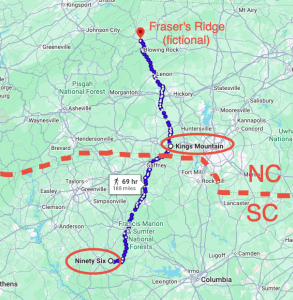
Meanwhile, in Book 9 — the basis of Season 8, which was centered around the Revolutionary War — we learned that the Loyalist militia was coming from a real place called Ninety Six, South Carolina — where my ancestors lived! — and that fictional Jamie fought in the real Battle of King’s Mountain in North Carolina— as did my 5th great-grandfather Thomas Thornton!
Or did he?
FUN FACT:
Where did Ninety Six, South Carolina get its name? No one knows for sure.
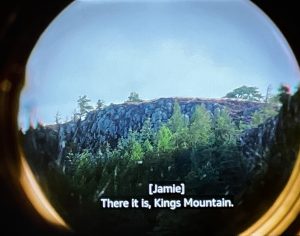
Jamie spots Kings Mountain in his spyglass.
Quakers & Loyalists
A story I heard decades ago, but after having traced my Thorntons back through several generations of Quakers, is that Thomas Thornton (1735-1783) was both a Quaker and a Loyalist. He not only supported the King during the Revolutionary War, he fought for him.
BLOG POST: Thornton Family History Lost and Found
The only problem with this (aside from his not being on the “right” side) is this: Quakers are widely known to be pacifists.
Could Kenneth Jacob Thornton have been wrong? He gave me a 468-page, loose-leaf 3-ring-notebook-bound copy of his “notes” before publishing The Thorntons in North Carolina: The Quaker Family in 1999. And sure, he could have been wrong. But I haven’t seen enough evidence to prove he was.
Horses & Zebras
There is a medical aphorism that goes like this: “When you hear hoofbeats, think horses, not zebras.” Clinicians are advised to look for common, likely diagnoses (horses) before considering rare ones (zebras). Coined by Dr. Theodore Woodward in the 1940s, it cautions against overthinking, though sometimes the cause is indeed a rare zebra.
FUN FACT: I got curious to see if the internet would back me up if I said that Dr. House, on the TV show House, specialized in “zebra” cases and found out that the original working title for the show was actually Chasing Zebras, Circling the Drain.
So, if Thomas Thornton was really both a Quaker and a Loyalist — not only loyal to King George III, but also fighting on his behalf — that would make him a zebra. The story goes on to say that he and his family were evacuated from Charleston (where his wife Elizabeth died) and transported to Nova Scotia (where he died). One of his sons, also named Thomas, was my 4th great grandfather.
Which Thomas Thornton?
The thing is, as is often the case in genealogy, there were several Thomas Thorntons in the area at the time. I’m looking at both North Carolina and South Carolina because the events and records of that era straddle the state line. And the boundary has changed over time.
In addition to the North Carolina Thornton vs. South Carolina Thornton argument, some Thornton descendants are offended that anyone would accuse their peace-loving Quaker ancestor of fighting, much less for the king. They consider it not only offensive, but ignorant. And they could be right. I haven’t seen any overwhelming evidence that clearly separates the two Thomas Thorntons, but as always, in genealogy, as well as in life, I’m open to new information.
If you have evidence besides “Quakers didn’t fight,” I’m all ears.
Things were complicated
I have learned, and it was also portrayed on Outlander, that men of all backgrounds either supported one side, or the other — or tried to stay out of the conflict altogether — in a number of ways. Some fought, some didn’t. Some were persecuted for fighting, others for not fighting. Fictional Jamie’s adopted son Fergus (a rebel at heart) ran a printing press. He felt it was important for people to be informed, and was harassed by both sides.
FUN FACT: Common Sense, a 47-page pamphlet advocating independence from Great Britain, was originally published anonymously. You may have heard of its author, though — a Quaker named Thomas Paine.
Sometimes people switched sides according to pressure from their neighbors and other reasons. Even Jamie Fraser’s allegiances shifted according to the political climate and the needs of his family. He initially acted as a Loyalist agent for the British Crown to protect his land and tenants in North Carolina. But he ultimately fought for the rebel cause and became an officer in the Continental Army. So it was a little confusing to me for awhile — wait, did he (fictitiously) fight with or against my ancestor?!
Did Quakers ever fight?
Here are a few facts:
- It was complicated for Quakers in the American Revolution as well. Quakers who refused to support the war often suffered for their religious beliefs at the hands of both non-Quaker Loyalists and Patriots.
- Yes, some Quakers did fight. Zebras do exist. And the ones who did were disowned by their meetings for participating in the war effort. Granted, sometimes “participation” did not always mean physical combat. For example, there was a Quaker in Outlander who was disowned for supporting the Rebels at the Battle of King’s Mountain as a surgeon (Denzell Hunter).
- Of those who were disowned, many were reinstated — after the war, and after condemning their own misconduct. Others simply fell away from the religion after that.
- Quaker records are simultaneously more extensive and less clear and complete than people think they are. If the contemporaneous meeting minutes mention Thomas Thornton, they don’t say “you know, the one who was born in 1735 and who died in 1783”. So you can’t always be sure which one they’re talking about. It could be your guy, his father, his son, his cousin, or his nephew. You have to know more about all of them (dates, locations, family members, migration patterns, etc.) to be sure.
- All records become sketchier the farther back in time you go.
FUN FACT: Another “known” thing about Quakers that wasn’t always true is that they were not slave owners. In fact, some did own slaves until they gave them up and migrated north and west to avoid the conflict of the Civil War. Slavery and war were both issues that the Society of Friends disagreed about and underwent growth pains over.
Bottom line
Ignoring the fact that one of them was real and the other is fictional, my Loyalist ancestor, Thomas Thornton, fought against the Rebel character Jamie Fraser in the Battle of Kings Mountain. Ugh! Sorry, Jamie!
That is, unless someone can prove to me that this fighting Thomas Thornton is not the father of my Quaker Thomas Thornton ancestor without using the “Quakers don’t fight” argument.
One thing is for sure — the intersection of fact and fiction makes this otherwise non-history-buff want to learn more about the time, place, and people! It’s time to review my own documentation and see if I can find an error, or some additional records to either strengthen my previous conclusions or disprove them. You know I love playing detective!

Are you a fan of Outlander?
Do you have an ancestor whose story dovetails historical fiction?
Please share with us in the comments!
- Hazel Thornton is an author, genealogist, and retired home and office organizer.
- Book: Hung Jury: The Diary of a Menendez Juror
- Book: What’s a Photo Without the Story? How to Create Your Family Legacy
- Book: Go With the Flow! The Clutter Flow Chart Workbook
- Feel free to link directly to this post! Click here to ask about other uses.
- Copyright 2026 by Hazel Thornton, Organized for Life and Beyond
__________________________________________________________________________________________
Share this:





I am one of the few people who has neither watched nor read Outlander, but I found this fascinating nonetheless. You inspire me to try and learn more about my own ancestors!
I’m glad you enjoyed it anyway, Janet! What more can I ask for than to have inspired someone?
❤️
You reminded me of how much I enjoyed watching several seasons of the “Outlanders.” Time to revisit it! Thanks for the nudge.
Enjoy! 🙂
I’ve never watched Outlander, but so many people have talked about it that I’m adding it to our list. Have to start that one after we finish The Way Home.
I went to a school whose mascot was the Quaker. As I cheerleader, leading cheers to “go, fight, win,” the apparent irony wasn’t lost on me LOL. If we truly were Quakers, we should have just walked away, right? Fun story about your ancestors. It’s neat to see how you follow a lead, Hazel.
That’s hilarious, Seana — The Fighting Quakers! I saw the first two seasons of The Way Home, but didn’t realize it was up to four seasons by now. Another time travel show!
I loved reading Outlander, and am contemplating reading the whole set 1-9 again, for the third or is it fourth, time? And I’d agree Jaime in my head from reading the books had much redder hair and was quite a bit taller than Sam Heughan, but I’ve grown to like Sam the actor. Although I haven’t finished watching the StarZ series, I was disenchanted (and my sister dropped her subscription…) a couple of seasons back. Tying it to your own “real” as you interpret it genealogy is very fun! I think the Samuel or Abraham Baileys (my maternal grandfather’s line) brushed by the Carolinas. Perhaps they lived near your Thorntons?! Or Elizabeth Starr Walker’s branch (maternal grandma’s) … not sure how they got to St. Louis. Those two sides were potentially here from the 1700s. Not sure I’ll research this anytime soon or ever, but it’s fun to think about. Thanks, Hazel!
It is, indeed, fun to think about!
I recall, in school, learning about the “Free Quakers” ( part of the Religious Society of Free Quakers, also called the “Fighting Quakers”) — perhaps that’s who you mean when you say some were forced out/disowned? My understanding was that (just as in World War II), Quakers, as a rule, did not join the fight. But given that they filled non-combatant roles during World War II (ambulance drivers, medics, etc.) during more modern wars, perhaps this was your ancestor’s involvement? (Not driving ambulances during the Revolutionary War, but offering support/succor of some other kind?
As you know, I love time travel stories, but back in the 1990s, I tried to get into Outlander and couldn’t make it past page 50 or so. For some reason, I couldn’t see these characters in my head. Perhaps with the delicious sight of Sam Heughan’s face and physique in mind, I can go back and read the books? I made it to season 2 and that got interrupted, but perhaps I’ll watch this summer.
It’s amazing how a topic that never interested me before knowing you has been transformed by your writing, Hazel. Genealogy is much more interesting when left in your capable hands. As for Scotland/North Carolina/Pangea, it just makes me think of the end of Dr. Doolittle, when the floating island joins the mainland, even with halves of trees lining up perfectly!
(And now I’m off to learn more about The Way Home!)
Fascinating stuff about the Quakers fighting. Lots of interesting stuff in here. 🙂 I have also not consumed Outlander in any form.
I tried reading (listening to an audiobook of) Outlander when I worked at my local library because so many patrons loved it. I couldn’t get past the sex and violence so that I could relate to the characters and I gave up. You made it sound so interesting that I might try again.
I have also puzzled over multiple people with the same name in my family tree. I can’t decide whether it makes it interesting or frustrating!
I suppose everyone has a limit to how much sex and violence that they can tolerate in a work of fiction. And, of course, you’d have to read/watch the whole saga to know how much of it is, or isn’t, sex and violence. In any case, I’m not trying to get you to try again. But, as for multiple people with same name in a family tree, the answer is YES — both interesting AND frustrating!
I can get it from the library, so if I have the same reaction, it can go right back. I have gone back to books that weren’t originally interesting to me and found I loved them after all, so I’ll give this one another try. An awful lot of library patrons told me how great it was!
I do find that whether or not I like a book can really depend on what else is going on in my life and what mood I’m in.
Well, I got the audiobook again and this time I LOVE it! I’m glad you mentioned it and that I decided to try again. Thanks!
Hey, thanks for letting me know!